
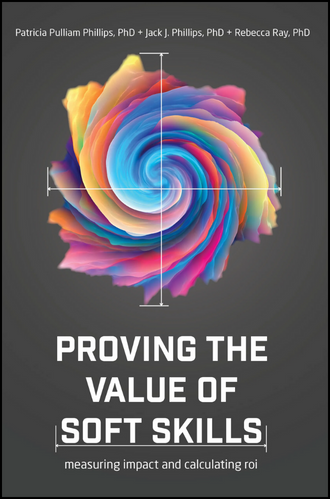
Description
In Proving the Value of Soft Skills, measurement and evaluation experts Patti Phillips, Jack Phillips, and Rebecca Ray contend that efforts can and should be made to demonstrate the effect of soft skills. They also claim that a proven methodology exists to help practitioners articulate those effects so that stakeholders’ hearts and minds are shifted toward securing support for future efforts.
This book presents the ROI Methodology, which is the most used evaluation system in the world. It is ideally suited for evaluating soft skills programs because it collects up to six types of data, representing five levels of outcomes, to show program success:
- Level 1. Reaction to the soft skills program.
- Level 2. Learning the skills and behaviors needed for success.
- Level 3. Application of skills and competencies.
- Level 4. Impact related to the application of soft skills competencies.
- Level 5. Financial return on investment, showing cost versus benefits.
- Intangible benefits connected to the program.
Intangibles are the impact measures not converted to money. In today’s climate, the funders, supporters, and sponsors of major soft skills programs need business impact and ROI data, but they may also be interested in the intangibles.
Proving the Value of Soft Skills offers a results-based approach. It uses design thinking to advocate processes and steps to design for, deliver, measure, and show the results of soft skills programs. The focus on designing for business results almost guarantees a positive ROI. This book also provides practical tools talent development managers and specialists can use to show the value of soft skills programs. The process moves from evaluation planning to data collection, where data is collected at four levels (reaction, learning, application, and impact). The analysis is next. In this step, the effects of the soft skills program must be sorted out from other influences and the impact data is converted to monetary value. The total costs of the soft skills program are tabulated, and these costs are compared with the monetary benefits to calculate the ROI. Along the way, the process incorporates conservative standards. Following this prescribed methodology ensures that soft skills programs deliver the desired business value.
The first part of the book offers a how-to reference for the ROI Methodology. Part II presents seven detailed case studies that show how to measure and evaluate soft skill programs and initiatives. The real-life case studies in this book show what is being measured, how it is being measured, how the data is used to improve soft skills programs, and how funding is being secured for future programs.
ISBN-10: 1950496635
ISBN-13: 978-1950496631